
Transmission Tower Foundations Construction in Nepal
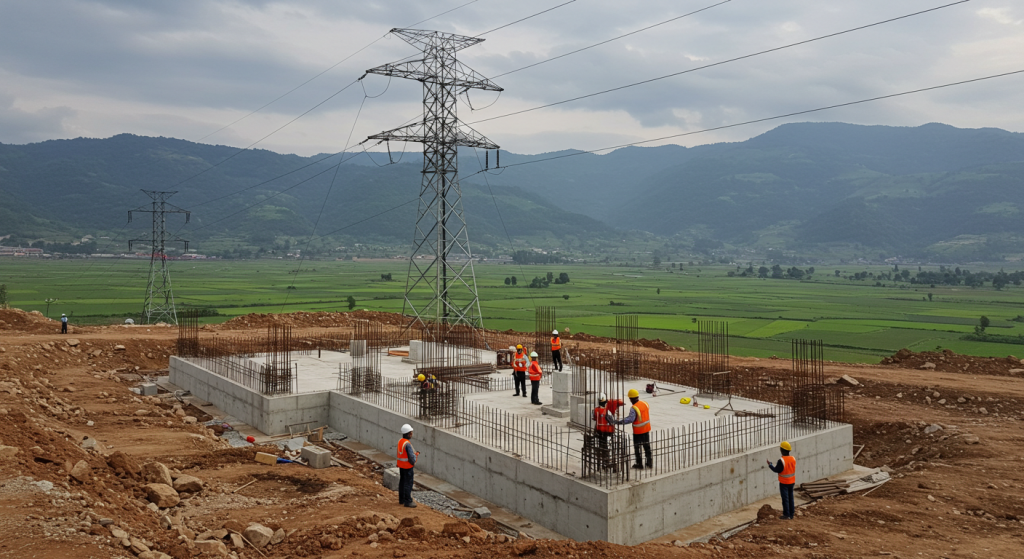
Building transmission tower foundations in Nepal requires more than standard engineering. From the low-lying Terai plains to steep Himalayan slopes, each site presents unique geotechnical and environmental challenges. Therefore, understanding how to design and construct foundations that endure these conditions is critical for power reliability and structural safety.
Understanding Terrain-Driven Challenges
Challenging terrains include unstable slopes, loose soils, waterlogged plains, and rocky mountain regions. Each introduces engineering risks such as slope failure, uneven load distribution, drainage issues, or anchoring difficulties. As a result, a one-size-fits-all approach is not effective in these conditions.
Effective planning begins with a geotechnical survey to determine soil type, bearing capacity, and groundwater presence. This step guides foundation selection and ensures material efficiency and long-term performance.
In addition, referencing standards such as the Nepal Electricity Authority (NEA) guidelines helps engineers evaluate site-specific parameters accurately.
Selecting the Right Foundation Type
Foundation type determines how a tower interacts with the ground. In complex terrains, design decisions must balance load-bearing requirements with constructability.
- Pile foundations are preferred for soft or submerged soils as they transfer loads into deeper, stable strata.
- Raft foundations distribute loads evenly across a broad base in weaker soils.
- Rock anchor foundations suit steep or rocky regions where deep excavation is impractical.
Integrating soil data and terrain analysis early helps prevent tilt, settlement, and long-term instability.

Ensuring Structural Stability for Transmission Tower Foundations
Beyond foundation type, stability depends on precision in excavation, reinforcement, and concreting. Engineers must monitor compaction, maintain correct anchor levels, and ensure consistent curing under varying climatic conditions. In hilly or riverine areas, retaining walls and proper drainage protect foundations from erosion and water pressure.
Routine inspections, material testing, and adherence to NEA and international standards ensure durable and safe transmission structures.
Integrating Safety and Sustainability
Construction in challenging terrains often overlaps with environmentally sensitive zones. Sustainable practices such as minimizing land disturbance, optimizing material usage, and controlled spoil management reduce ecological impact. These measures also lower future maintenance costs.
Worker safety is equally important. Planned access routes, slope stabilization, and protective systems during excavation and concreting safeguard personnel and maintain project continuity.
Technology and Field Coordination
Modern surveying and mapping technologies have transformed how foundation design adapts to terrain. Drone-based topography mapping, LiDAR scans, and GPS-enabled layout tools improve precision and efficiency. When combined with experienced local teams, these technologies ensure that field conditions are accurately reflected in final foundation designs.
Partner with Tebina Construction for Reliable Power Infrastructure
Transmission infrastructure in Nepal is expanding into more challenging terrains than ever before. Reliable transmission tower foundations construction in Nepal require careful integration of geotechnical data, stable foundation systems, and sustainable field practices. Consequently, engineers can ensure that the country’s power network remains resilient and safe over decades.
Tebina Construction applies these principles in every project it undertakes. For inquiries or collaboration, visit the Contact Page.

