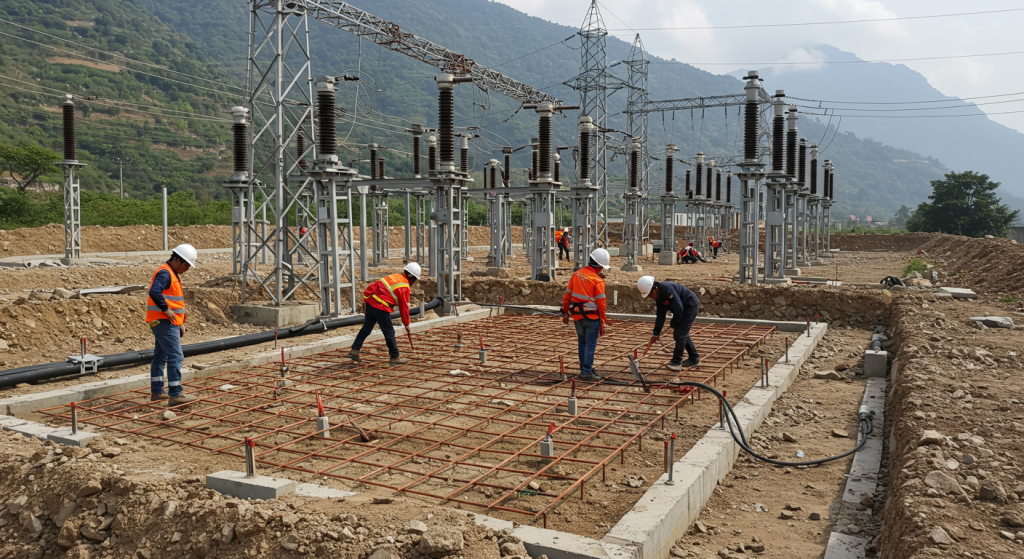

Reliable substations rely on a robust earthing system. Proper substation earthing protects equipment, personnel, and operations from electrical faults and surges. In Nepal, with its diverse terrains, precise planning and execution are critical for long-term operational stability and safety.
For projects involving complex foundations, our work on Transmission Tower Foundations in Nepal demonstrates how terrain-specific engineering ensures stability. Similarly, accurate load calculations, as discussed in our Pole Erection Load Calculations blog, complement reliable substation infrastructure.
Understanding Soil Resistivity and Its Impact
Soil resistivity plays a key role in grounding efficiency. High-resistivity soils can reduce the dissipation of fault currents, creating step and touch voltage hazards. Conducting soil resistivity tests allows engineers to design grounding grids tailored to site conditions, ensuring effective current distribution and operational safety.

Designing Effective Earthing Grids
The layout of an earthing grid determines how fault currents safely dissipate into the ground. Engineers consider:
- Grid geometry: Optimizing mesh size and electrode spacing for efficient current flow.
- Electrode type: Copper rods, strips, or plates are selected based on soil type and load expectations.
- Connections: Proper bonding ensures uniform voltage distribution and minimal ground potential rise.
A well-designed grid not only enhances safety but also improves the long-term reliability of the substation.
Monitoring Ground Resistance for Long-Term Safety
Ground resistance can change over time due to soil moisture, corrosion, or structural shifts. Implementing long-term monitoring with digital resistance meters and clamp-on testers allows engineers to track performance and address issues proactively.
Integrating technology such as GPS-enabled layouts and data logging systems improves accuracy during installation and ongoing maintenance, ensuring the earthing system performs reliably under all conditions.
Conclusion
Proper substation earthing methods form the backbone of safe, stable, and reliable substations. Tebina Construction applies these strategies in every project, ensuring operational stability and long-term safety.
To learn more, visit our website at www.tebina.com.np


